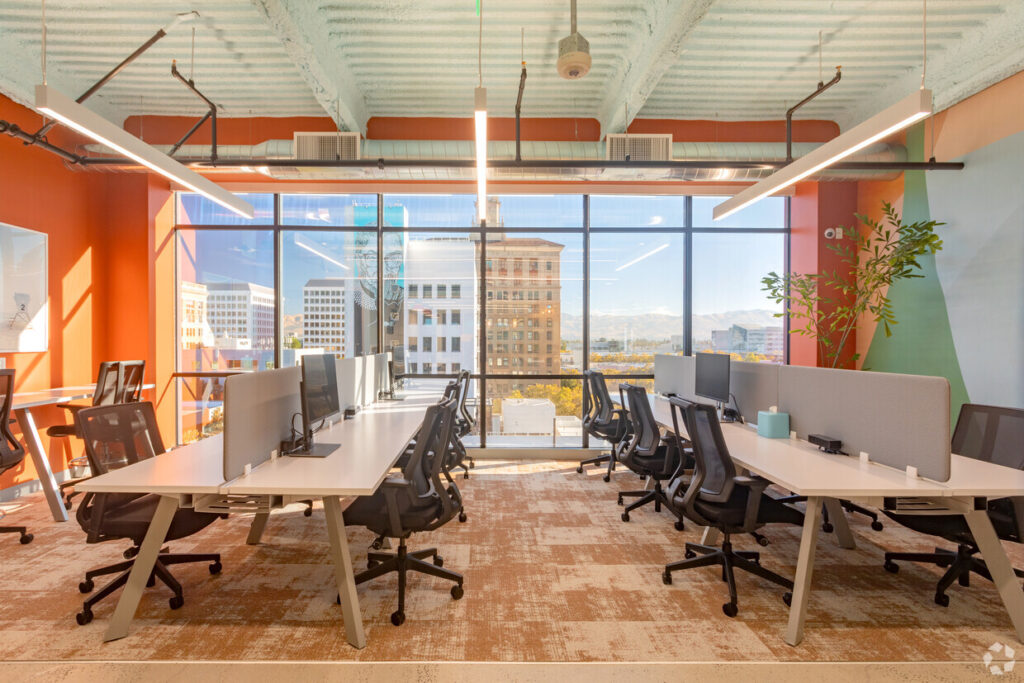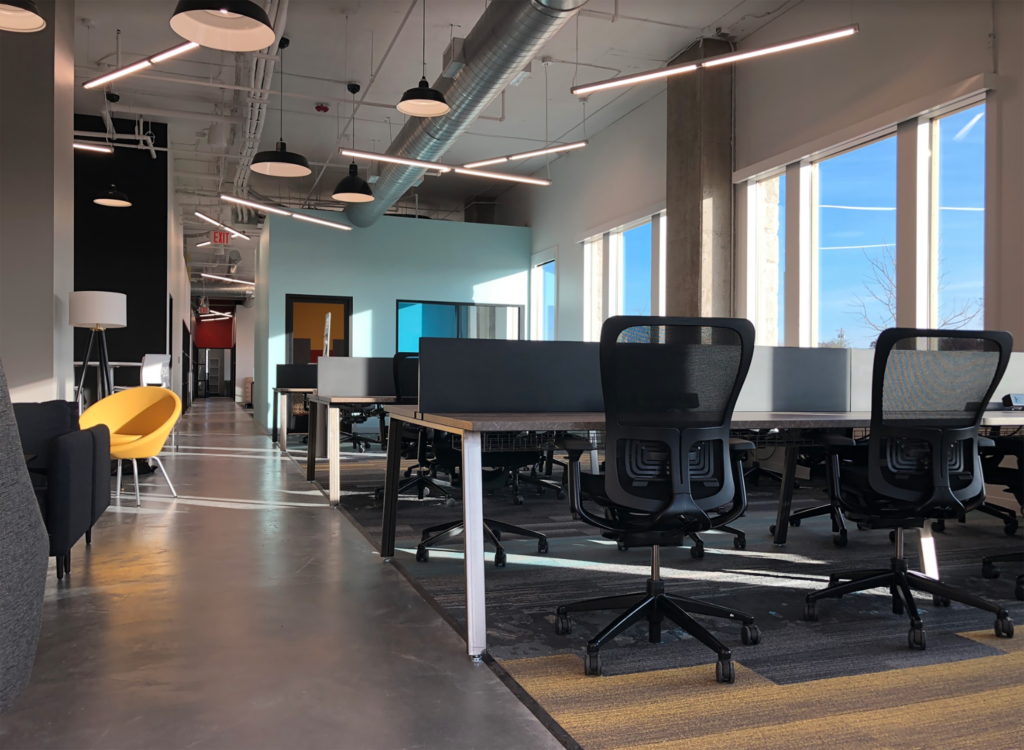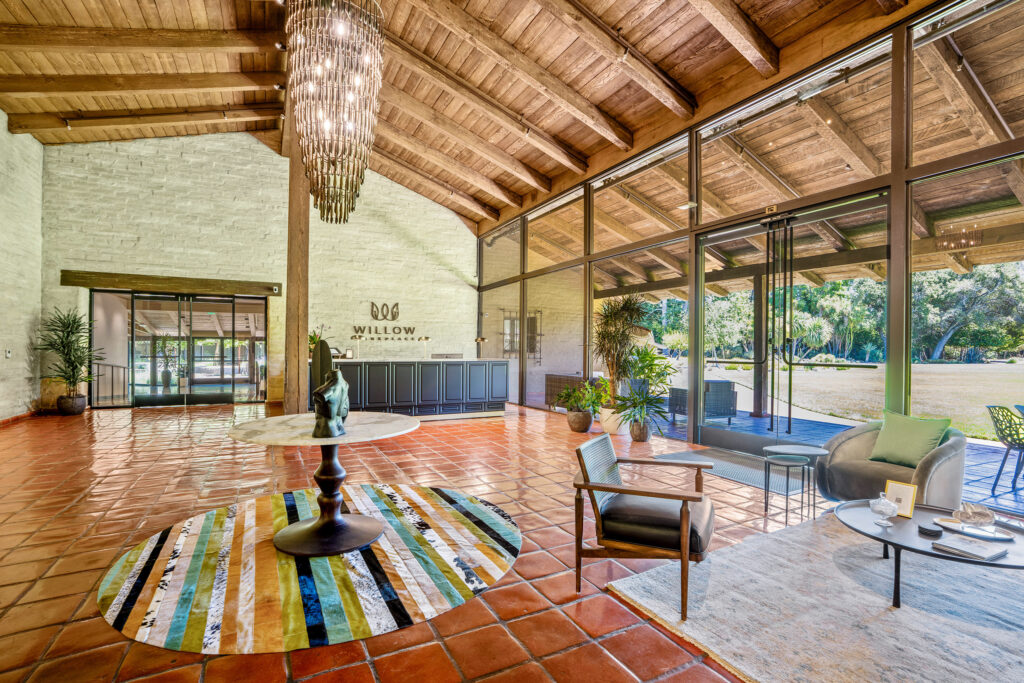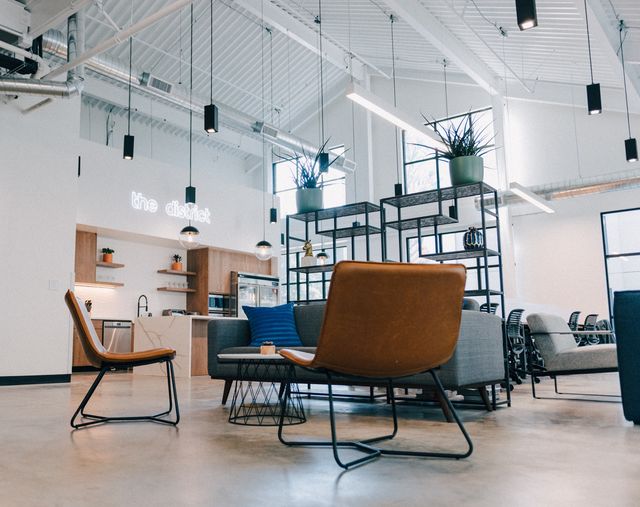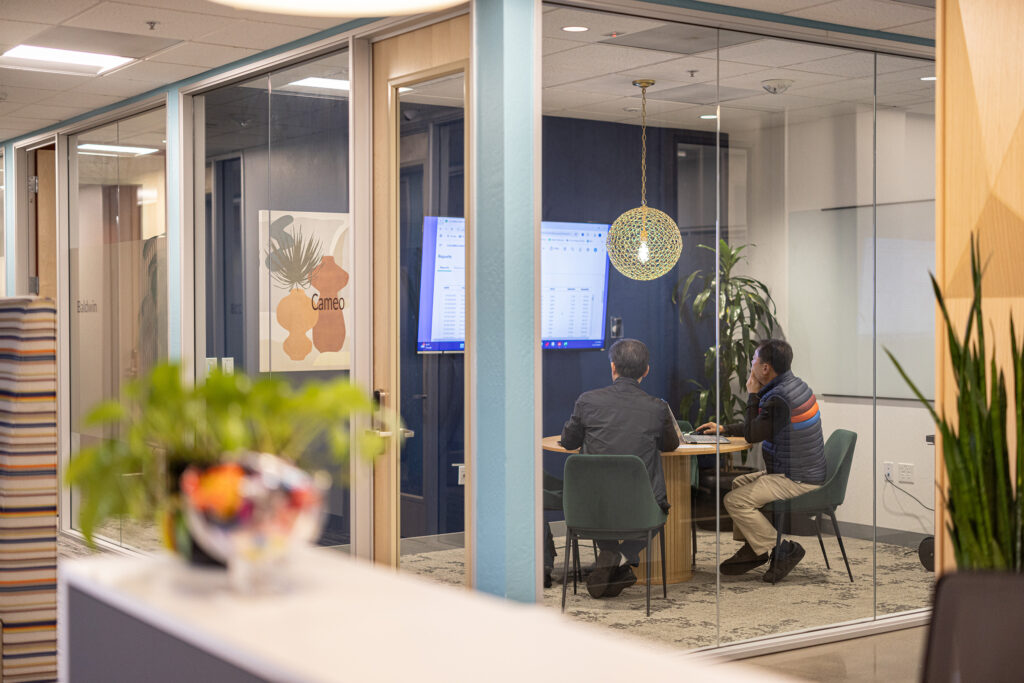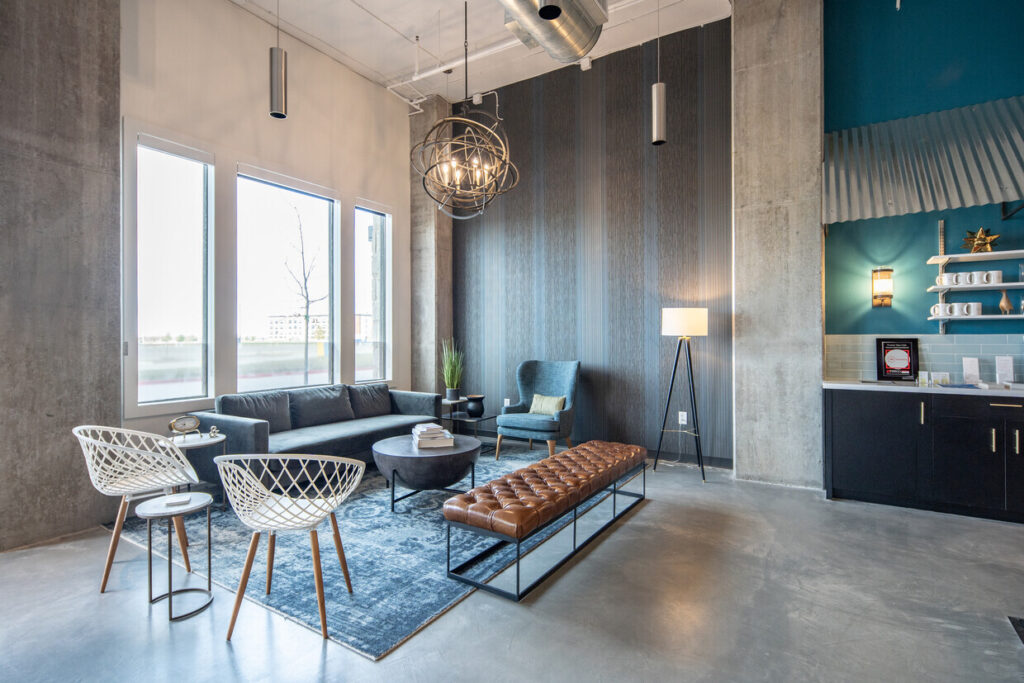
FF&E stands for furniture, fixtures, and equipment, the movable and non-permanent elements that help a commercial interior function. In an office, that might include desks, task chairs, conference tables, lounge furniture, lighting, storage, artwork, accessories, and equipment selected specifically for the space.
That definition is straightforward. The role FF&E plays in successful office interior design is much more interesting.
Furniture, fixtures, and equipment are sometimes thought of as the layer that comes after the important design decisions have been made. The architecture is established, the floor plan is complete, and then it’s time to decide what goes inside.
In reality, FF&E decisions can influence how people move through a space, where they collaborate, whether they can concentrate, how easily a workplace can change, and even whether the original design works as intended.
FF&E isn’t simply what fills a finished space. It’s part of what makes the space work.
What Does FF&E Include?
The exact definition of FF&E can vary somewhat by project, but the term generally describes movable items that are not permanently attached to the building.
In a commercial workplace, FF&E may include:
| Category | Examples |
| Furniture | Desks, workstations, task chairs, conference tables, lounge seating, café furniture, storage and shelving |
| Fixtures | Decorative lighting, freestanding partitions, certain window treatments and other non-permanent interior elements |
| Equipment | Monitors, conference room equipment (such as AV equipment, LED monitors, video conferencing, sonos system), appliances and other operational equipment |
| Accessories | Artwork, rugs, decorative objects, planters and other finishing elements |
FF&E is generally distinguished from permanent architectural and building components such as walls, doors, built-in millwork, plumbing, mechanical systems, and other elements that become part of the building itself.
The distinction matters for budgeting, purchasing, accounting, construction coordination, and project management. From a design perspective, though, there is another consideration: permanent and non-permanent elements still need to work together as one environment.
FF&E Shouldn’t Be What You Think About After the Design Is Finished
Consider something as simple as a conference table.
Its dimensions influence how many people can comfortably use the room. Its shape affects sightlines and conversation. Power and technology need to work with its location. Chairs require clearance behind it. Lighting needs to correspond with where people are seated, and cameras and screens need to accommodate everyone around the table.
Suddenly, selecting a table isn’t just selecting a table.
The same relationships exist throughout a workplace. Workstation dimensions influence circulation. Lounge furniture can encourage conversation or create privacy. Storage affects how clean and functional a space remains. Furniture placement can determine whether employees gravitate toward a shared environment or rarely use it.
These relationships are particularly important in conference rooms and event spaces, where furniture may need to work alongside technology, acoustics, sightlines, circulation, and changing room configurations.
This is why FF&E should enter the design conversation early. The architecture, space plan, technology, furniture, materials, lighting, and ways people will use the space all influence one another.
When those decisions are made together, the finished workplace feels cohesive. When they’re made independently, compromises often appear later.
The Right FF&E Isn’t Necessarily the Most Beautiful Option
A product can look perfect in a showroom and still be wrong for the project.
Commercial interiors ask much more of furniture than appearance alone. A chair in a reception area, for example, may be used by hundreds or thousands of people over its lifespan. A café table might be a lunch table at noon, an informal meeting space at 2 p.m., and an individual workstation later in the afternoon.
Each FF&E specification involves a series of considerations.
How will the product be used? How frequently? Is it appropriately scaled for the space? Is it comfortable? Can its finishes withstand the expected level of use? How easily can it be cleaned or repaired? Does it support the desired flexibility? What is the warranty? Can replacement components be sourced later?
Then there are the project realities: price, availability, lead time, freight, installation, and compatibility with everything around it.
The question isn’t simply, “Do we like this?”
A better question is, “Does this product earn its place in this environment?”
That shift in thinking is one of the differences between selecting furniture and thoughtfully specifying FF&E. It also reflects a larger principle of corporate office interior design: the most successful workplaces aren’t built around isolated design choices, but around how those choices work together to support the people using the space.
FF&E Is Where Design Meets Human Behavior
Some of the most important FF&E decisions aren’t really about furniture. They’re about people.
Imagine a workplace designed to encourage collaboration. Adding a large communal table may seem like an obvious solution, but whether people actually use it depends on much more than the table itself.
Where is it located? Is it in a natural circulation path or somewhere employees rarely pass? Does it feel appropriate for conversation, or does using it make people feel as though they’re disturbing nearby coworkers? Is there power? Is the lighting comfortable? Are there alternative spaces when someone needs privacy?
The same thinking applies to focus rooms, lounges, cafés, meeting spaces, reception areas, and individual workstations.
People don’t experience FF&E as a list of individual products. They experience environments.
That is why understanding how people are expected to behave within a space should inform what goes into it. This is especially important when designing corporate offices, where the furniture mix needs to support different modes of work while reinforcing the organization’s brand and culture.
Lowest Price and Best Value Aren’t Always the Same Thing
Budget matters in every FF&E project. But evaluating furniture purely by initial purchase price can create a misleading picture of cost.
Two task chairs may serve the same basic purpose and have very different price points. The less expensive option might appear to offer better value until durability, ergonomics, warranty coverage, replacement parts, and expected lifespan enter the equation.
The same applies to tables, lounge furniture, storage, lighting, and other FF&E.
This doesn’t mean the most expensive product is automatically the best choice. It means value needs context.
Some spaces justify a greater investment because products will experience heavy daily use. Other areas may provide opportunities to allocate budget differently. The goal is to understand where quality and performance matter most and where a more economical selection can accomplish the same objective.
Thoughtful FF&E planning is partly an exercise in deciding where the budget will have the greatest impact.
FF&E Specification and FF&E Procurement Are Different
Specification and procurement are closely connected, but they solve different problems.
FF&E specification determines what should go into the space and why. It involves selecting products, manufacturers, dimensions, quantities, materials, finishes, performance requirements, and other details necessary to achieve the intended design and function.
FF&E procurement determines how those selections actually get into the space. It includes activities such as requesting and evaluating vendor proposals, confirming pricing, coordinating purchasing, tracking orders and lead times, managing logistics, reviewing invoices, scheduling deliveries, and overseeing installation.
One establishes the intent. The other carries that intent through execution.
Keeping the two connected matters because conditions inevitably change between initial selection and installation. Products can become unavailable. Lead times can shift. Prices change. A manufacturer may discontinue a finish. Construction schedules move.
When specification and procurement are considered as part of the same process, those changes can be evaluated against the larger design rather than addressed as isolated purchasing decisions.
Workplace Studio’s FF&E procurement and furniture specification services connect these two sides of the process, from initial product selection through vendor coordination, purchasing, delivery, and installation.
Lead Times Can Become Design Decisions
One of the less visible realities of FF&E is that availability can influence design.
Imagine that a particular lounge chair is integral to the concept, but its lead time extends several months beyond the planned occupancy date.
There are several possible responses. Wait for it. Select an alternative. Use temporary furniture. Adjust the schedule. Reconsider that area of the design.
None of those decisions is purely logistical.
An alternative chair may have different dimensions, requiring the layout to change. A different upholstery could alter the material palette. Another manufacturer may offer different durability or warranty coverage. The substitute may require a different power solution or no longer coordinate with adjacent furniture.
A procurement problem has become a design problem.
This is one reason product availability and lead times should be considered early rather than after every selection has been finalized. Understanding those constraints gives the team more options and reduces the likelihood of rushed substitutions later.
There Is a Lot of Work Between “Approved” and “Installed”
From the client’s perspective, approving an FF&E package can feel like a major finish line.
Operationally, it is closer to the middle.
Before products arrive, specifications need to become orders. Pricing and quantities must be confirmed. Vendors need coordination. Deposits and invoices need to be tracked. Lead times need monitoring. Delivery dates have to correspond with construction progress and site readiness.
Then the furniture starts moving.
Who receives it? Where is it stored if the site isn’t ready? What happens if something arrives damaged? Are elevators reserved? Is there enough loading access? Which products need assembly? Does installation happen in phases? Are power and data ready where furniture is being placed?
None of these questions is particularly glamorous.
All of them can affect whether the space opens successfully.
Strong FF&E procurement is largely about anticipating those details before they become problems. On a larger commercial office fit out, that also means coordinating furniture procurement and installation with construction schedules, site readiness, vendors, and the planned occupancy date.
Flexibility Doesn’t Mean Putting Everything on Wheels
Flexibility is a common goal in commercial interior design, particularly as organizations plan for workplaces that may continue to change.
But flexible FF&E isn’t synonymous with movable furniture.
The more useful question is: What is likely to change?
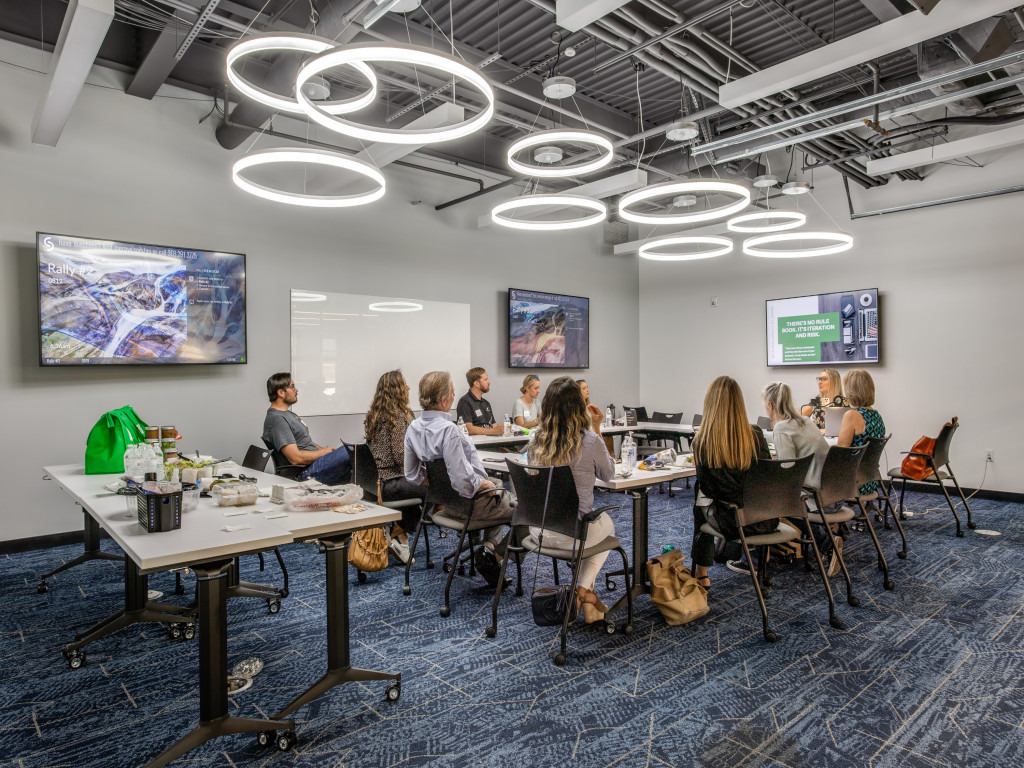
A training room may regularly transition between classroom, presentation, and workshop configurations. Flexibility is important there. A private office might need to accommodate different users or an additional workstation over time. A café may need to support dining, informal meetings, and company gatherings.
Those are identifiable needs that can inform furniture selection.
Trying to make every part of a workplace endlessly reconfigurable can introduce compromises in comfort, acoustics, storage, durability, and even aesthetics.
Good flexibility is purposeful. It anticipates the changes that are reasonably likely to happen and makes those changes easier.
This same principle applies beyond traditional offices. In coworking spaces, for example, furniture may need to support changing team sizes, different work modes, meeting configurations, and member needs without making every part of the space endlessly adaptable.
The Best FF&E Decisions May Not Be the Ones People Notice
When people enter a well-designed workplace, they may notice a beautiful lounge, an interesting light fixture, or a distinctive piece of furniture.
They probably won’t notice that the conference chairs have enough clearance behind them. They won’t think about why power is exactly where they need it or why a lounge feels comfortable having a conversation without feeling exposed.
They won’t know that a fabric was selected because it can withstand years of commercial use, that a workstation system can accommodate future changes, or that a product was chosen partly because replacement components will remain available.
They’ll simply experience a space that works.
Some of the most successful FF&E decisions are almost invisible because they remove friction rather than call attention to themselves.
Think Beyond Opening Day
Commercial interiors are often photographed immediately after completion, when every chair is perfectly positioned and every surface is untouched.
That is one moment in a much longer life of the space.
A better measure of FF&E is what happens after six months, two years, or five years of actual use.
Are the materials holding up? Can furniture accommodate changes in team size or work patterns? Are people using spaces as intended? Can damaged components be repaired rather than replacing an entire product? Does the workplace still support the organization as it evolves?
These questions shift the definition of successful FF&E away from how the space looks on opening day and toward how well it continues to perform.
And that is ultimately why furniture, fixtures, and equipment deserve to be part of the design conversation from the beginning.
FF&E sits at the intersection of design intent, human behavior, operational needs, budget, and real-world execution. When those considerations are addressed together, furniture becomes much more than what fills the space.
It becomes part of what makes the space successful.
From FF&E Specification Through Installation
Workplace Studio approaches FF&E as an integral part of the overall design, considering how furniture, fixtures, and equipment support the space, the people using it, and the experience the design is intended to create.
Our FF&E procurement and furniture specification services carry those decisions from product selection through vendor coordination, purchasing, delivery, and installation, helping protect both design intent and project objectives along the way.
Ready to bring the details together? Contact Workplace Studio to discuss your project.